Relocation Guide for International Buyers & Expats
Relocating to Washington, DC
Updated November 2026
Relocating to Washington, DC from abroad? This guide covers what it is like to live here as an international buyer or expat: the community and neighborhoods international residents may want to consider, where to eat, how the market looks today, and how the buying process works for non-US citizens. Claude Labbe, a REALTOR® with Douglas Elliman Real Estate at 1027 33rd St NW in Georgetown, Washington DC, helps international buyers and expats make these decisions with clarity, discretion, and thoughtful execution.
The Community
Washington DC's International Community
Washington DC is one of the most international cities in the United States. Nearly a quarter of the DC metro population is foreign-born, more than 168 languages are spoken across the region, and 176 embassies call the city home. Whatever your country of origin, you will find a community, a cultural center, and a lifestyle not far from your front door.
Walkability is a big part of the appeal. DC's overall Walk Score is 77, and the neighborhoods international residents favor score far higher: Dupont Circle at 98, Capitol Hill at 88. Daily errands, schools, and restaurants are within easy reach on foot in the city's walkable core.
The region also offers a strong set of international schools, including the Washington International School in Cleveland Park, the British International School of Washington in Georgetown, the Lycee Rochambeau French International School in Bethesda, the German International School in Potomac, and the public charter DC International School.
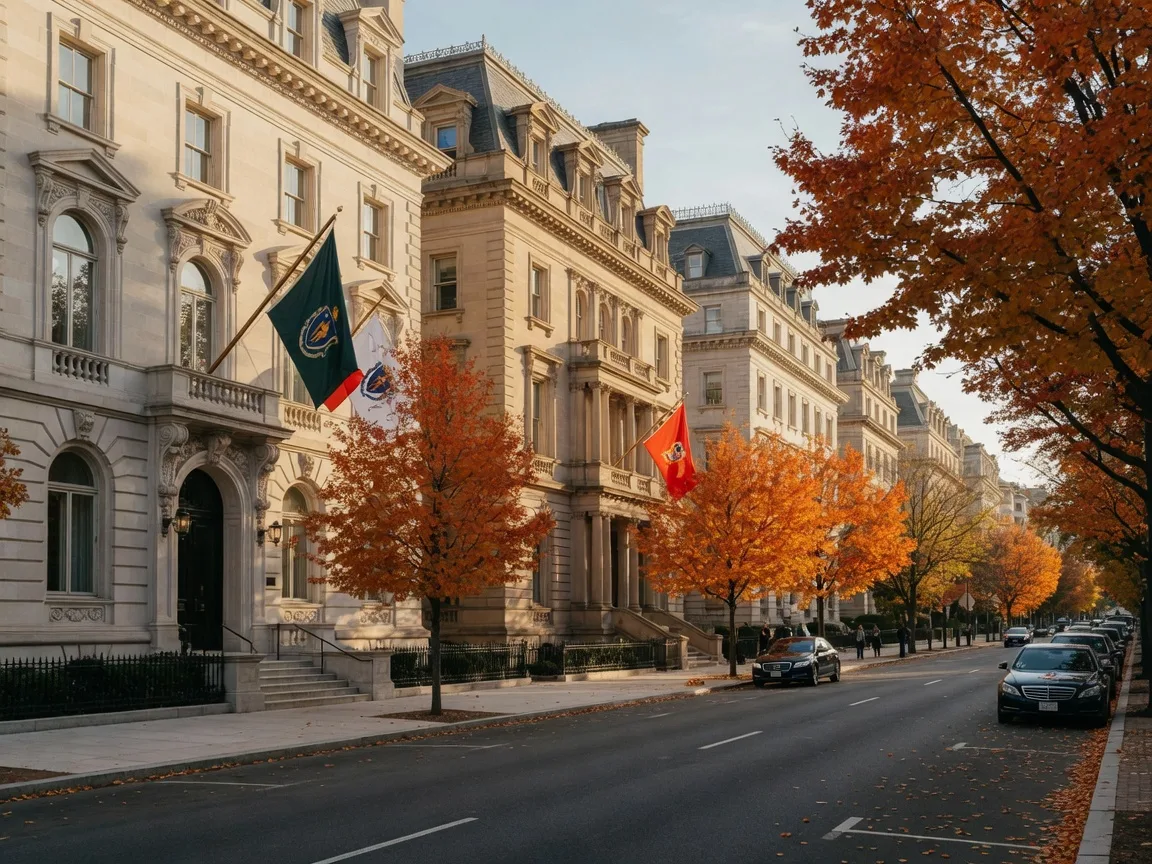
These neighborhoods cover the city's NW core plus areas west of Rock Creek Park, where many international residents choose to live.
Dupont Circle & Kalorama
The heart of Embassy Row along Massachusetts Avenue, with historic mansions, global restaurants, and a Walk Score of 98.
Georgetown
Waterfront dining, university energy, high-end shopping, and the British International School of Washington along the Potomac.
Foggy Bottom
Home to the State Department, George Washington University, and the World Bank and IMF. Heavily diplomatic and walkable.
Woodley Park & Cleveland Park
Tree-lined streets near Rock Creek Park, the Smithsonian National Zoo, and top international schools.
Capitol Hill
The political center with the city's largest historic residential district, popular with diplomats and staffers. Walk Score 88.
Adams Morgan
A cosmopolitan crossroads with Central and South American, Caribbean, African, and European communities and diverse dining.
American University Park & Spring Valley
Home to American University, with tree-lined residential streets west of Rock Creek Park.
Chevy Chase
A stately residential NW neighborhood along Connecticut and Wisconsin Avenues, bordering Maryland.
Tenleytown
A walkable NW hub on Wisconsin Avenue with its own Metro station.
Friendship Heights
A shopping-focused neighborhood on the DC line with Maryland, along Wisconsin Avenue.
Beyond the City: Suburban Options in Maryland and Virginia
Different buyers have different needs, and the DMV has a wide range of options to consider. Many international residents choose to live outside DC, in the suburbs of Maryland and Virginia.
Maryland Suburbs
Bethesda and Potomac offer established neighborhoods, strong schools, and Metro access, and Potomac is home to the German International School.
Virginia Suburbs
Arlington, McLean, and Reston sit close to Dulles International Airport, and the Virginia side is home to many foreign employers and a strong tech corridor.
Market Conditions
The DC Market Right Now
$677K
DC Median Home Price
3 months ending Aug 2026, down about 1.8% YoY · Redfin
~57
Median Days on Market
DC homes, 3 months ending Aug 2026 · Redfin
4.8
Months of Supply, DC
A near-balanced market as active listings rise
The Washington DC market is cooling in activity, not in price. Inventory has climbed roughly 33% year over year, and the District now sits near a balanced market with about 4.8 months of supply. Well-priced homes in desirable neighborhoods still draw strong demand, while condos offer more room for negotiation. For a fuller picture, see the DC Metro market report and the October 2026 market update.
It is also worth knowing that the DMV is a secure and proven real estate market that has often avoided the sharp ups and downs felt across the US in recent decades. The region did not appreciate as quickly as most of the US in the 2020s, so it is widely seen as relatively good value against future expectations.
FAQ
Questions International Buyers Ask
Can a foreign national buy property in Washington DC?
Can an expat on a US work visa get a mortgage?
How does the closing process work for an international buyer in DC?
What taxes apply when I buy a home in DC?
Which neighborhoods are best for international buyers?
Is now a good time to buy in Washington DC?
How long does it take to ship household goods to Washington, DC from overseas?
Do I have to pay customs duties on household goods when moving to the United States?
What should I arrange before moving into a Washington, DC condo from overseas?
International Relocation Logistics
Shipping Household Goods to Washington, DC From Abroad
Finding the right home is only one part of relocating internationally. Getting your belongings to Washington, DC, Maryland or Virginia requires planning, particularly when coordinating shipping schedules, customs clearance and your move-in date.
The following practical guidance was contributed by Sasha Ravich, owner of Shepherd International Movers.
Coordinate Your Shipment and Move-In Dates
Book your shipment once visas, start dates and your closing or lease arrangements are confirmed, so your belongings do not arrive before you can receive them.
Choose the Right Shipping Method
A full household usually travels in its own container. A smaller move can share a container at a lower cost but a slower pace. Air freight suits a few boxes you need right away.
Plan for International Shipping Times
Ocean shipments to the East Coast often take one to two months or more door to door, depending on the country of origin. Consider temporary furnished accommodation during the transition.
Prepare Your US Customs Paperwork
Used household goods may qualify for duty-free entry, subject to US Customs and Border Protection requirements. CBP Form 3299 and a detailed inventory may be required. Diplomatic and international-organization staff should ask their employer about separate procedures.
US Customs and Border Protection: importing household goodsArrange Delivery to Your New Home
Many Washington, DC condo buildings require a certificate of insurance and a reserved elevator. Rowhouse streets may require a temporary parking permit for the moving truck. Discuss these requirements with your mover early.
Verify Your International Moving Company
Check the applicable Federal Maritime Commission licensing or registration requirements before hiring an international ocean mover. Ask for a written quote that separates origin, ocean and destination charges.
Federal Maritime Commission: OTI licensing and certificationContributed by Sasha Ravich, Owner, Shepherd International Movers.
Website: Shepherd International Movers
Phone: 818-539-8866
This information is provided for general relocation planning. Independently verify shipping arrangements, customs requirements and service provider credentials. Inclusion does not constitute an endorsement by Claude Labbe or Douglas Elliman Real Estate.
Mortgage Calculator
Estimate Your Monthly Payment
A quick estimate of principal and interest plus property tax and insurance. This is a planning tool, not a lender quote. International buyers should plan for a larger down payment (often 25% to 30%) on foreign national loans.
Please enter a home price greater than zero.
Estimates use standard amortization and do not include condo fees, HOA dues, mortgage insurance, or the recordation and transfer taxes discussed above. For a precise figure tied to your situation, get a quote from a lender who understands foreign national lending.
From the Blog
Related Reading
Planning a move to Washington?
A conversation now saves time, stress, and money when it matters most.