Key Takeaways
- Rowhouses anchor the DC housing market: row houses make up about 24% of the District's housing stock (DC Office of Planning), and most were built between the 1860s and the 1930s.
- Historic districts touch much of rowhouse DC: the city has 70 historic districts, and exterior work on a rowhouse inside one needs preservation review before permits are issued.
- The 2026 market rewards prepared buyers: ZIP 20003 on Capitol Hill closed August at a $872,500 median sold price, up 9.1% year over year, and well-priced rowhouses near Eastern Market go under contract within about two weeks.
- Budget for the building, not just the price: old systems, masonry upkeep, and preservation-compatible materials add real cost, which is exactly what a thorough inspection is for.
Buying a rowhouse in Washington DC comes down to one question: what do you want to change about it? These attached brick houses are the city's signature home type, and because much of the rowhouse stock sits inside historic districts, the answer shapes everything from your offer to your renovation budget. Here is what to know before you shop, including the neighborhoods to watch, the preservation rules that govern change, and what the 2026 market looks like.
What Makes a DC Rowhouse Different
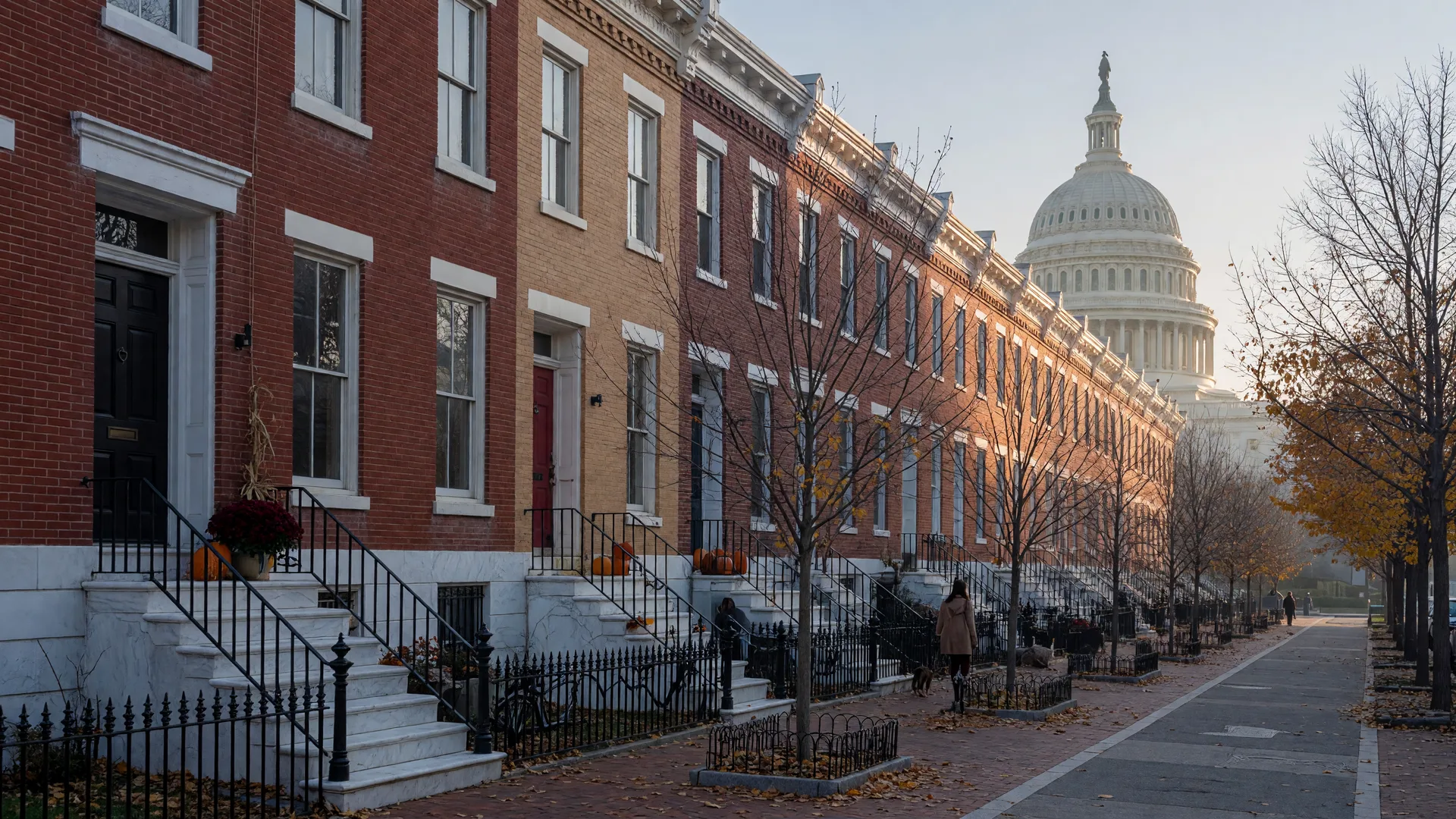
A rowhouse is an attached brick home, typically two to four stories, built on a deep, narrow lot with a shared party wall on each side. Washington's rows went up mostly between the 1860s and the 1930s, driven by the federal workforce that flooded the city after the Civil War and kept arriving through the early twentieth century. That history is why the city still reads as a place of brick sidewalks, marble stoops, and front doors opening straight onto the street.
The designs vary by era. Federal and Georgian rows dominate Georgetown, Italianate houses with bracketed cornices line Capitol Hill, and Queen Anne and Richardsonian Romanesque facades fill Shaw, Dupont Circle, and Bloomingdale. What holds across all of them is the footprint: narrow, vertical, and sunny at the rear, with public rooms stacked rather than spread out. A DC rowhouse is a lifestyle choice as much as a building choice, and the lifestyle is an urban one.
Row houses make up about 24% of the District's housing stock, down from 27% in 2000, according to the DC Office of Planning's Housing Element. Most are fee simple, which means you own the house and the land under it with no condo board or HOA fee. The trade-off is the party wall: you share structure with the neighbors on both sides, so a roof, parapet, or foundation project on one house often touches the next one.
Where To Find Rowhouses in Washington DC
Capitol Hill has the deepest rowhouse blocks in the city, centered on Eastern Market at 225 7th Street SE and Barracks Row along 8th Street SE. ZIP 20003 is the core of that market, and the Capitol Hill neighborhood guide lays out the blocks, schools, and commuting picture in detail.
Georgetown is the other great rowhouse district, with Federal-era houses on brick sidewalks around M Street, Wisconsin Avenue, and the C&O Canal. Georgetown's houses sit inside their own historic district, and preservation review there runs through the Old Georgetown Board under the US Commission of Fine Arts. The Georgetown neighborhood guide covers the market and lifestyle there.
Dupont Circle, Logan Circle, Shaw, Bloomingdale, Columbia Heights, and the H Street corridor all have strong rowhouse streets, many restored over the last twenty years. The rowhouse ZIPs run from 20002 and 20003 on the Hill through 20036 and 20037 around Dupont Circle to 20009 in Logan Circle and 20010 in Columbia Heights. Each area has a different price point and a slightly different buyer, so compare the Dupont Circle neighborhood guide with the others on this site before you set your search area.
Historic District Rules: What You Can Change and What You Can't
Washington has 70 historic districts, according to the DC Office of Planning, covering most of the classic rowhouse neighborhoods. If a house sits inside one, or is itself a designated landmark, exterior work needs preservation review before the city issues a building permit. The rule protects the very character you are buying; it also shapes what you can do with the place once you own it.
The process is more workable than most buyers expect. In-kind repairs, like replacing a window or door in the same material, and minor changes that do not alter a building's character are approved administratively by the Historic Preservation Office, often within a few days. Substantial alterations, additions, and demolitions go to the nine-member Historic Preservation Review Board (HPRB), which meets monthly and offers an early concept review so you get design feedback before you commit to plans. The DC Office of Planning explains which review path applies to your project. Georgetown properties go through the Old Georgetown Board instead of HPRB.
There is no separate preservation permit. You file a building permit with the DC Department of Buildings, and the preservation clearance is part of that review. Buyers who plan a side or rear addition, a rooftop deck, or changes to the front facade should ask about historic status before they offer, because that status sets the design bar from day one.
Budgeting for an Older Building
The purchase price is only the start. A rowhouse built in 1900 carries more than a century of systems, and the inspection is where the real budget takes shape. Expect to look hard at the roof and parapets, brick and mortar, windows, plumbing, and electrical service. A good inspector who works on historic masonry regularly is worth seeking out rather than settling for whoever is first available.
Preservation-compatible replacements cost more than modern substitutes. Wood windows, fired-clay roofs, and lime-based repointing are the kinds of materials historic districts expect, and they carry a price premium over vinyl, asphalt, and modern blends. Add a sewer scope to the inspection list; DC's rowhouse sewer laterals are old, and a lateral repair is one of the larger surprise expenses a new owner can hit.
There is no HOA to lean on, which is a plus for control and a minus for maintenance. Party wall repairs are usually coordinated between neighbors, and a careful title review will surface any shared agreements recorded against the property. Renovation money also does not always translate into appraisal value: if your plans push the total past what comparable resales support, you can land in an appraisal gap. The explainer on what an appraisal gap means for your sale covers exactly how that plays out, and the same logic applies on the buying side of the table.
Buying a Rowhouse in Washington DC: What the 2026 Market Looks Like
The rowhouse market in DC is strong but selective. On Capitol Hill, ZIP 20003 closed August 2026 at a median sold price of $872,500, up 9.1% year over year, with a median 14 days on market, down 48% (local market reports reviewing Bright MLS data). Redfin put the Capitol Hill neighborhood median near $925,000 over the three months ending May 2026, while the citywide DC median ran near $677,000.
The pattern repeats across the rowhouse neighborhoods. Well-priced houses near the commercial cores sell in a weekend or two, and overpriced ones sit for months. Citywide, DC homes close at about 98.1% of list price (Redfin, August 2026), so the number on the sign is close to the number on the settlement statement when it is set from current comps. For a look at what is on the market right now, browse current Capitol Hill listings on Zillow for the 20003 zip.
Mortgage rates still drive the math. The 30-year fixed mortgage averaged 7.28% in the first week of October 2026 (Freddie Mac), up from 6.34% a year earlier. At that rate, the monthly payment sets your range, and pre-approval comes before touring. For the regional picture, the county-by-county breakdown of the DMV market shows how DC compares with Montgomery and Fairfax, and if you will also be selling a rowhouse, the post on what days on market really tells you before you list applies directly to the Hill.
How To Buy a Rowhouse Without Regrets
A rowhouse is a great fit when you want character, walkability, and an efficient footprint in a true city neighborhood. It is a poor fit when you need acres, an attached garage, or the freedom to change the facade without review. Match the house to the way you actually live, not to the way the street looks in October.
- Get pre-approved first. At 7.28%, the payment decides the range, and sellers on competitive blocks read the financing terms before they read the offer letter.
- Check historic status before touring. It changes what you can do and what you will spend, so pull it early rather than discovering it after an offer is accepted.
- Use an agent who knows the rowhouse neighborhoods. The buyer side here has its own rhythm: first-weekend offers, escalation clauses, and well-known inspection issues on old masonry.
- Inspect hard. Structural, termite, roof, electrical, and a sewer scope are worth every dollar on a 1900 building.
- Price your renovation to reality. Preservation-compatible materials cost more, and major projects that need HPRB review take longer than a new build.
The step-by-step buying guide walks through the whole process from pre-approval to closing, including DC's specific deadlines and disclosures. And when you are weighing what a renovation will add to your property tax bill, the post on how much property taxes run across the DMV puts the DC numbers in perspective. When you find the right house, the process itself should feel calm; that is what a well-run transaction does.

Claude Labbe
REALTOR · Douglas Elliman · DC, MD, VA
Claude Labbe is a REALTOR with Douglas Elliman, working from the firm's Washington DC office at 1027 33rd St NW in Georgetown. With 24 years in real estate across DC, Maryland, and Virginia, he advises accomplished, time-constrained buyers and sellers who want clarity, discretion, and execution. He is licensed in DC (98365123), Maryland (577123), and Virginia (0225069761).